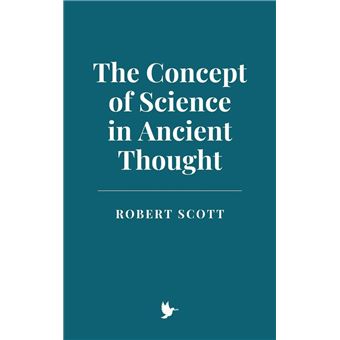
The Concept of Science in Ancient Thought

Resumen
This work explores the evolution of scientific thought from ancient civilizations to the dawn of the modern era, offering a comprehensive analysis of the key figures, ideas, and discoveries that shaped humanity's understanding of the natural world. Beginning with the mythological and philosophical interpretations of nature in early cultures, such as Mesopotamia, Egypt, and pre-Columbian Mesoamerica, it traces the intellectual trajectories of ancient Greek philosophers, including the Pre-Socratics, Pythagoras, Plato, and Aristotle. Special attention is given to the interplay between empirical observation and metaphysical speculation, particularly in the scientific methodologies of classical antiquity.
The narrative continues through the Hellenistic period, focusing on the scientific advancements in Alexandria, where figures such as Euclid, Archimedes, and Eratosthenes expanded the boundaries of mathematics, engineering, and astronomy. The Roman Empire's contributions to applied science and infrastructure are explored, alongside the Persian and Zoroastrian traditions that preserved and enriched ancient knowledge. The Islamic Golden Age is presented as a pivotal era of synthesis and innovation, highlighting scholars like Al-Khwarizmi, Ibn Sina, and Ibn al-Haytham, who advanced algebra, medicine, optics, and astronomy.
In medieval Europe, monastic centers and universities played a critical role in preserving classical texts and fostering intellectual revival through translation movements and the adoption of Aristotelian philosophy. The Renaissance is portrayed as a period of intellectual rebirth, marked by figures such as Leonardo da Vinci, Copernicus, and Vesalius, who combined empirical observation with humanistic inquiry. The culmination of this intellectual journey is the Scientific Revolution, during which scholars like Galileo, Kepler, and Newton formalized the scientific method and articulated universal laws that redefined humanity's place in the cosmos.
By examining primary sources, historical contexts, and the contributions of diverse civilizations, this study demonstrates that scientific progress is not the product of a single culture or era but rather a cumulative and collaborative endeavor spanning millennia. The work underscores the importance of cross-cultural exchange, empirical inquiry, and critical reflection in the development of science, arguing that the pursuit of knowledge is a universal and evolving process that continues to shape the modern world.

eBook con Kobo by Fnac
Miles de libros en cualquier parte gracias al libro electrónico de Kbo by Fnac. Una experiencia de lectura óptima tan cómoda con leer un libro en papel
DescubrirOpiniones de clientes
Sé el primero en dar
tu opinión sobre el producto
Características
- ISBN
-
9798230657606
- SKU
-
1007725507