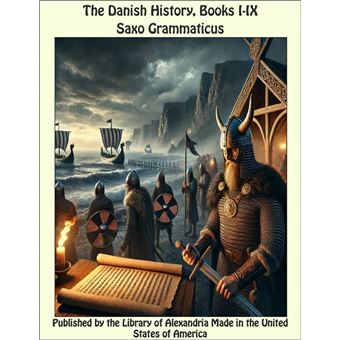
The Danish History, Books I-IX

Resumen
Saxo Grammaticus, or "The Lettered", one of the notable historians of the Middle Ages, may fairly be called not only the earliest chronicler of Denmark, but her earliest writer. In the latter half of the twelfth century, when Iceland was in the flush of literary production, Denmark lingered behind. No literature in her vernacular, save a few Runic inscriptions, has survived. Monkish annals, devotional works, and lives were written in Latin; but the chronicle of Roskild, the necrology of Lund, the register of gifts to the cloister of Sora, are not literature. Neither are the half-mythological genealogies of kings; and besides, the mass of these, though doubtless based on older verses that are lost, are not proved to be, as they stand, prior to Saxo. One man only, Saxo's elder contemporary, Sueno Aggonis, or Sweyn (Svend) Aageson, who wrote about 1185, shares or anticipates the credit of attempting a connected record. His brief draft of annals is written in rough mediocre Latin. It names but a few of the kings recorded by Saxo, and tells little that Saxo does not. Yet there is a certain link between the two writers. Sweyn speaks of Saxo with respect; he not obscurely leaves him the task of filling up his omissions. Both writers, servants of the brilliant Bishop Absalon, and probably set by him upon their task, proceed, like Geoffrey of Monmouth, by gathering and editing mythical matter. This they more or less embroider, and arrive in due course insensibly at actual history. Both, again, thread their stories upon a genealogy of kings in part legendary. Both write at the spur of patriotism, both to let Denmark linger in the race for light and learning, and desirous to save her glories, as other nations have saved theirs, by a record. But while Sweyn only made a skeleton chronicle, Saxo leaves a memorial in which historian and philologist find their account. His seven later books are the chief Danish authority for the times which they relate; his first nine, here translated, are a treasure of myth and folk-lore. Of the songs and stories which Denmark possessed from the common Scandinavian stock, often her only native record is in Saxo's Latin. Thus, as a chronicler both of truth and fiction, he had in his own land no predecessor, nor had he any literary tradition behind him. Single-handed, therefore, he may be said to have lifted the dead-weight against him, and given Denmark a writer. The nature of his work will be discussed presently. Nothing is stranger than that a work of such force and genius, unique in Danish letters, should have been forgotten for three hundred years, and have survived only in an epitome and in exceedingly few manuscripts. The history of the book is worth recording. Doubtless its very merits, its "marvellous vocabulary, thickly-studded maxims, and excellent variety of images," which Erasmus admired long afterwards, sealed it to the vulgar. A man needed some Latin to appreciate it, and Erasmus' natural wonder "how a Dane at that day could have such a force of eloquence" is a measure of the rarity both of the gift and of a public that could appraise it. The epitome (made about 1430) shows that Saxo was felt to be difficult, its author saying: "Since Saxo's work is in many places diffuse, and many things are said more for ornament than for historical truth, and moreover his style is too obscure on account of the number of terms ("plurima vocabula") and sundry poems, which are unfamiliar to modern times, this opuscle puts in clear words the more notable of the deeds there related, with the addition of some that happened after Saxo's death." A Low-German version of this epitome, which appeared in 1485, had a considerable vogue, and the two together "helped to drive the history out of our libraries, and explains why the annalists and geographers of the Middle Ages so seldom quoted it."
eBook con Kobo by Fnac
Miles de libros en cualquier parte gracias al libro electrónico de Kbo by Fnac. Una experiencia de lectura óptima tan cómoda con leer un libro en papel
DescubrirOpiniones de clientes
Sé el primero en dar
tu opinión sobre el producto
Características
- ISBN
-
9781465503633
- SKU
-
1002916720